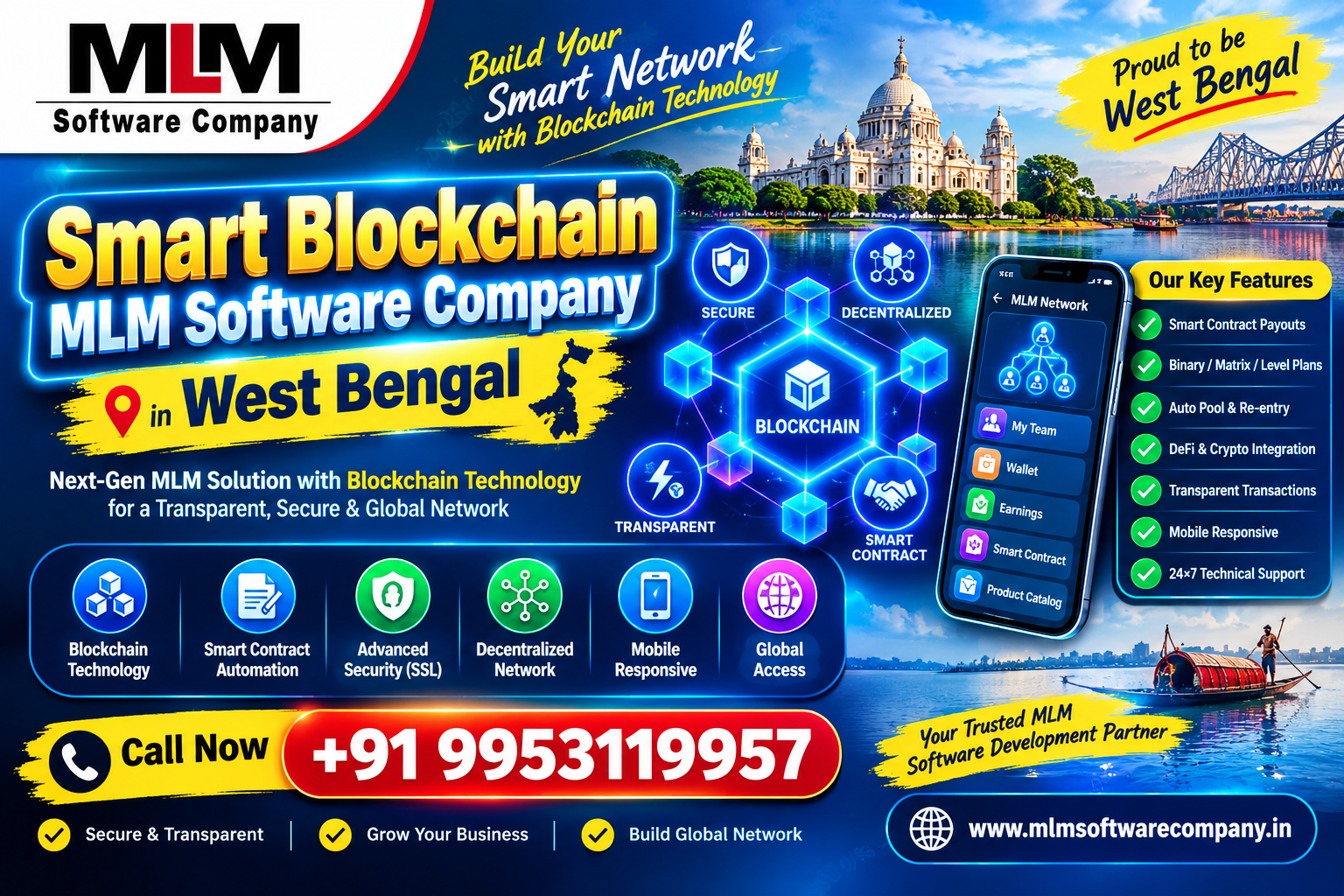
The direct selling and network marketing industry is increasingly adopting digital technologies to improve business management, transparency, and operational efficiency. For businesses looking to modernise their network marketing operations, Smart Blockchain MLM Software in West Bengal offers a technology-driven approach to managing distributor networks, tracking transactions, and automating commission calculations. From Kolkata to Howrah, Durgapur, Siliguri, Asansol, and other growing business locations, companies can explore blockchain-based software solutions to support their business requirements.
A professional MLM Software Company in West Bengal can help businesses develop customised network marketing platforms with features such as member registration, referral management, genealogy trees, commission calculation, e-wallet management, reporting, and blockchain integration. The right solution depends on the business model, the compensation plan, the number of users, and the level of decentralisation required.
What Is Smart Blockchain MLM Software?
Smart Blockchain MLM Software is a network marketing management system that combines traditional multi-level marketing software with blockchain technology. Traditional MLM software generally stores business information in a centralised database, whereas blockchain-based systems can record selected transactions on a distributed ledger.
Smart contracts are programs deployed on a blockchain that execute predefined instructions when specified conditions are met. In a properly designed MLM platform, smart contracts may automate certain commission rules, transaction records, or eligible payouts.
For example, a company may configure a system to calculate commissions according to verified product sales and its approved compensation plan. Depending on the architecture, the calculation may happen within the main software, on a blockchain, or through a combination of both.
It is important to understand that blockchain does not automatically make a business model legitimate or guarantee profits. The software must be designed around genuine business activity, clearly documented rules, appropriate security controls, and applicable laws.
Why Choose a Smart Blockchain MLM Software Company in West Bengal?
West Bengal has business communities across retail, distribution, e-commerce, technology, and direct selling. Businesses in Kolkata, Howrah, Siliguri, Durgapur, Bardhaman, Asansol, and other areas may need software that can manage growing distributor networks and provide reliable business records.
Choosing a suitable Smart Blockchain MLM Software Development Company can help a business establish a more organised digital infrastructure.
Key advantages include:
-
Improved transaction transparency: Blockchain records can make supported transactions independently verifiable.
-
Automated commission calculations: Software can calculate commissions using predefined rules and verified business data.
-
Better network management: Admins can manage distributors, referrals, sales, and team structures from one platform.
-
Detailed reporting: Dashboards can display sales performance, commission records, transaction history, and member activity.
-
Scalable architecture: A properly designed platform can support business expansion as user numbers and transaction volumes increase.
-
Integration possibilities: The platform may connect with payment providers, e-commerce systems, customer relationship management tools, and supported blockchain wallets.
The benefits depend on the implementation. Businesses should evaluate transaction costs, processing speed, privacy requirements, security, and maintenance before selecting a blockchain network.
Important Features of Smart Blockchain MLM Software
A modern Blockchain MLM Software Company in West Bengal should understand both MLM business operations and blockchain development. The following features are worth considering when planning a new platform.
1. Smart Contract Integration
Smart contracts can encode selected business rules, such as eligibility conditions and commission distribution logic. Once deployed, changing contract logic may require a carefully planned upgrade or migration, depending on the contract design.
Before deployment, the rules should be tested against different business scenarios to identify calculation errors and unexpected outcomes.
2. Automated MLM Commission Management
The commission engine calculates earnings based on the company's approved compensation plan. Depending on the model, it may support direct referral commissions, level commissions, matching bonuses, or other permitted incentives.
A reliable system should provide a clear breakdown of how each commission was calculated and allow authorised administrators to review relevant records.
3. Binary MLM Plan Software
A binary plan places distributors into two primary branches, often described as the left and right legs. The software can track team structures, eligible sales volume, matching calculations, and applicable payout limits.
The commission rules must be clearly defined so that distributors can understand how their earnings are calculated.
4. Matrix MLM Plan Software
Matrix MLM software manages a network according to a predetermined width and depth. For example, a 3×7 matrix may allow three positions at each level across seven levels, subject to the specific plan design.
The platform can manage placement, referral relationships, matrix progression, and eligible bonuses.
5. Level and Unilevel MLM Software
Level-based plans calculate commissions according to specified levels within a distributor's network. Unilevel plans generally permit a distributor to sponsor multiple people directly, with compensation rules defining which levels qualify for commissions.
Software should distinguish between referral relationships, placement structures, and commission eligibility to avoid inaccurate calculations.
6. Blockchain Transaction Tracking
For supported on-chain transactions, the system can display transaction hashes, timestamps, wallet addresses, and confirmation status. Users may be able to verify transactions through a compatible blockchain explorer.
However, not every activity in an MLM platform needs to be stored on-chain. Personal information and confidential business data should generally be protected off-chain with appropriate access controls.
7. Digital Wallet Integration
A digital wallet integration can allow users to connect compatible wallets or view supported transaction activity. Depending on the business requirements, the platform may also support deposits and payouts through approved payment channels.
Wallet integrations require careful security planning. Businesses should establish controls for private-key management, transaction authorisation, fraud prevention, and recovery procedures.
8. Admin and Distributor Dashboards
The admin dashboard should provide tools for managing members, products, orders, commissions, payout requests, and reports. The distributor dashboard should allow members to review their referral links, network structure, eligible earnings, and transaction history.
A mobile-friendly interface and clear navigation can make the platform easier to use for distributors across West Bengal and other regions.
9. Security and Audit Trails
A reliable platform should consider:
-
Multi-factor authentication for sensitive accounts.
-
Role-based access controls for administrators and staff.
-
Encryption for sensitive information.
-
Regular backups and recovery procedures.
-
Smart contract testing and independent security reviews.
-
Monitoring for suspicious account activity and transactions.
-
Detailed records of administrative changes.
Blockchain immutability is not a substitute for secure application development. Vulnerabilities in smart contracts, wallet integrations, or the centralised parts of the platform can still expose a business to risk.
Which Blockchain Is Suitable for MLM Software?
The appropriate blockchain depends on the business's technical requirements, expected transaction volume, available wallet ecosystem, transaction fees, and supported assets.
Common options include:
-
Ethereum: A widely used smart contract platform with an established development ecosystem.
-
BNB Smart Chain: An EVM-compatible blockchain that supports smart contracts and compatible wallets.
-
TRON: A blockchain used for certain token transfers and smart contract applications.
-
Layer-2 networks: Certain Ethereum-compatible networks may provide alternative transaction-cost and performance characteristics.
These options are not interchangeable in every situation. Developers should evaluate current network fees, reliability, security, tooling, token standards, and integration requirements before making a decision.
The platform should also clearly identify the blockchain and token standard used for every supported transaction. For example, the same token name may exist on multiple networks, and sending assets to an incompatible address or network can cause loss of funds.
How Does Blockchain MLM Software Work?
A typical implementation may follow these steps:
Step 1: Member registration: A distributor registers through the website or application and completes the required verification process.
Step 2: Referral and network setup: The system records sponsorship relationships and assigns the member according to the approved MLM plan.
Step 3: Product or service transaction: A qualifying order or other legitimate business transaction is recorded.
Step 4: Commission calculation: The commission engine evaluates the transaction against the applicable plan rules and eligibility conditions.
Step 5: Smart contract execution: Where appropriate, a smart contract processes the on-chain component according to its programmed rules.
Step 6: Transaction verification: Supported blockchain transactions can be checked through the relevant network explorer.
Step 7: Reporting and reconciliation: The admin and member dashboards display the available transaction, commission, and payout information.
Not every platform performs every step on-chain. A hybrid architecture may be more appropriate where the business needs both efficient database-based management and verifiable blockchain transactions.
How to Select the Best MLM Software Company in West Bengal
Choosing the right software provider is an important business decision. Before selecting a Smart Blockchain MLM Software Development Company in West Bengal, consider the following points.
Business-plan understanding: Confirm that the developer understands your exact binary, matrix, unilevel, generation, or hybrid compensation structure.
Working demonstration: Request a demo that demonstrates actual member registration, commission calculations, transaction records, and administrative controls.
Smart contract quality: Ask about code reviews, automated testing, testnet deployment, independent security audits, and upgrade procedures.
Data and source-code ownership: Clarify who owns the source code, customer data, smart contracts, and deployment credentials. Review the contract terms before signing.
Security and support: Check how the provider handles updates, backups, technical issues, incident response, and ongoing maintenance.
Transparent pricing: Request an itemised proposal covering development, integrations, hosting, blockchain fees, audits, and future support.
Legal and regulatory review: Confirm that the business model, compensation structure, product sales, payment flows, and marketing claims comply with applicable Indian law.
A local presence may be helpful for meetings and training, but it should not replace technical verification, contractual clarity, or a review of the software itself.
Legal and Compliance Considerations in India
Blockchain technology does not exempt an MLM business from Indian laws and regulations. Businesses should review the Consumer Protection (Direct Selling) Rules, 2021, applicable amendments and state requirements, consumer protection obligations, taxation, data protection, and payment regulations with qualified professionals.
The business model should focus on genuine products or services and lawful sales activity rather than recruitment-only rewards or promises of guaranteed returns. Pyramid schemes and prohibited money-circulation arrangements can create serious legal risks.
If the platform uses cryptocurrency or token-based payments, additional considerations may include applicable tax obligations, anti-money-laundering requirements, reporting duties, payment restrictions, and other rules relevant to the specific activity. A blockchain developer cannot replace legal or tax advice.
Benefits for Businesses Across West Bengal
A well-planned Smart Blockchain MLM Software Company in West Bengal solution can serve businesses operating in several locations.
-
Kolkata: Network marketing operations, distributor management, and digital sales administration.
-
Howrah: Member management and commission reporting for growing distribution businesses.
-
Durgapur and Asansol: Centralised reporting and network management for businesses serving regional markets.
-
Siliguri: Digital coordination for businesses operating across multiple locations.
-
Bardhaman, Kharagpur, and other districts: Online member access, reporting, and business administration.
The platform can be configured for regional expansion, with features such as mobile access, suitable language options, and multi-location reporting where required. Actual performance will depend on the business model, implementation quality, and operational processes.
Future of Smart Blockchain MLM Software
Blockchain development, automated business processes, and digital commerce continue to create new opportunities for software innovation. Future MLM platforms may combine smart contracts with improved analytics, mobile applications, API integrations, automated reconciliation, and enhanced fraud monitoring.
However, adopting new technology should begin with a clearly defined business need. Companies should evaluate whether blockchain offers meaningful benefits over a conventional database-based MLM system rather than assuming decentralisation is always the best option.
For a business planning to launch or upgrade its network marketing platform, a customised solution can be designed around its compensation structure, product catalogue, user experience, reporting needs, and compliance requirements.
Conclusion
A Smart Blockchain MLM Software Company in West Bengal can help businesses explore modern solutions for distributor management, transparent transaction tracking, commission automation, and network marketing administration. By combining carefully designed MLM software with appropriate blockchain integration, companies can build a platform that supports operational efficiency and clearer record-keeping.
Before investing in a solution, compare providers, test the compensation calculations, review smart contract security, clarify ownership terms, and obtain professional compliance advice. A well-planned technology platform should support a legitimate business model rather than rely on unrealistic earning promises.
If you are researching an MLM Software Company for your business, begin by documenting your compensation plan, transaction workflow, required integrations, and security expectations. These details will help you select a solution that fits your actual business requirements.
Frequently Asked Questions (FAQs)
1. What is Smart Blockchain MLM Software?
Smart Blockchain MLM Software combines network marketing management features with blockchain technology. Depending on its architecture, it can support smart contract execution, verifiable transactions, automated commission rules, and digital wallet integration.
2. Why should I choose a Blockchain MLM Software Company in West Bengal?
A suitable provider can help design software around your business plan, member network, reporting requirements, and technical needs. When evaluating a provider, prioritise its development experience, testing process, security practices, support arrangements, and contractual terms.
3. Can blockchain MLM software support Binary and Matrix plans?
Yes. A platform can be designed to support binary, matrix, unilevel, level-based, and certain hybrid compensation plans. The implementation must accurately reflect the company's approved rules and applicable legal requirements.
4. Are smart contract MLM payouts automatic?
They can be automatic when the relevant eligibility conditions are satisfied and the contract is configured to execute the payment. Network fees, insufficient balances, contract restrictions, network congestion, or other technical issues may delay or prevent a transaction.
5. Is blockchain MLM software completely secure?
No software is completely secure. Blockchain can make certain records difficult to alter, but smart contract bugs, compromised wallets, stolen credentials, application vulnerabilities, and operational mistakes remain possible. Testing, security reviews, monitoring, and incident-response planning are essential.
6. Which blockchain is best for MLM software development?
There is no universally best blockchain. Ethereum, BNB Smart Chain, TRON, and compatible Layer-2 networks have different technical characteristics and costs. The best choice depends on supported assets, transaction volume, wallet compatibility, security requirements, and current network conditions.
7. Can MLM software support cryptocurrency payments?
Technically, a platform may support selected cryptocurrencies or tokens, depending on the blockchain and payment integrations. Businesses must verify the relevant legal, tax, payment, and compliance requirements before enabling these features.
8. What is the difference between traditional MLM software and blockchain MLM software?
Traditional MLM software usually manages records in a centralised database controlled by the operator. Blockchain MLM software adds distributed-ledger functionality and may use smart contracts for selected rules or transactions. A hybrid system combines both approaches.
9. How much does Smart Blockchain MLM software development cost?
The cost depends on the number of features, compensation-plan complexity, smart contract requirements, blockchain integrations, mobile applications, security audits, and ongoing support. Request a customised quotation with a clear breakdown of development and maintenance costs.
10. How long does it take to develop blockchain MLM software?
The timeline depends on project scope, integrations, testing, security reviews, and deployment requirements. A basic prototype generally requires less work than a production platform involving complex compensation rules, wallet integrations, and independently reviewed smart contracts. Ask the developer for a milestone-based project plan.
11. Can members track their commissions and transactions online?
Yes. A properly designed member dashboard can display commission statements, referral information, order history, payout requests, and supported blockchain transaction details. Access to sensitive information should be restricted to authorised users.
12. What should I check before hiring an MLM software development company?
Review the working demo, commission-calculation accuracy, source-code ownership, data export options, smart contract testing, security practices, support policy, pricing, and legal compliance requirements. Make sure the contract clearly explains deliverables and responsibilities.
13. Is blockchain MLM software suitable for small businesses?
It may be suitable when blockchain verification or smart contract automation provides a clear business benefit. Smaller businesses should compare the added development, transaction, audit, and maintenance costs with those of a conventional MLM platform before deciding.
14. Does blockchain guarantee higher income for MLM members?
No. Blockchain is a technology for recording and executing certain transactions; it does not guarantee sales, business success, or income. Earnings depend on the legitimate business model, product demand, operating costs, and applicable compensation rules.
Suggested final CTA: Looking for an MLM Software Company to develop a smart, scalable network marketing platform? Define your business requirements, compare technical solutions, and request a detailed demonstration before choosing your development partner.