The Future of MLM Software in Odisha
The direct-selling and network marketing industries are exploring new technologies to improve transparency, automate commission calculations, and simplify business management. One technology attracting attention is blockchain, particularly smart contracts that can execute predefined business rules automatically.
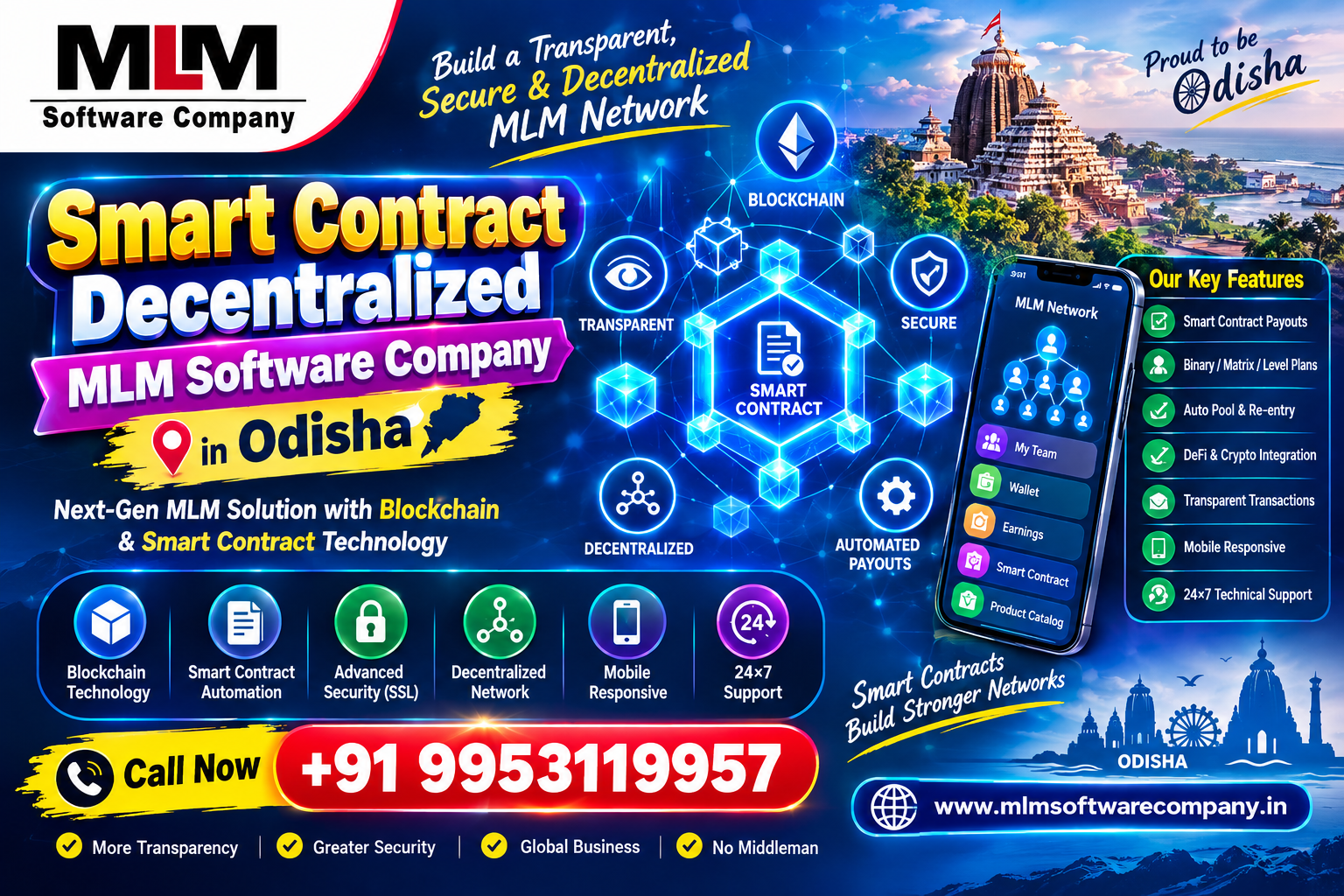
A Smart Contract Decentralized MLM Software Company in Odisha can help businesses explore blockchain-based network marketing platforms, member management systems, automated commission calculations, and decentralized applications.
Whether you are planning to establish an MLM business in Bhubaneswar, Cuttack, Rourkela, Sambalpur, Berhampur, or another part of Odisha, understanding decentralized MLM software can help you make informed technology decisions.
However, technology alone does not guarantee business success. A sustainable MLM platform needs a genuine product or service, transparent compensation rules, appropriate security controls, and compliance with applicable Indian laws.
What Is Smart Contract Decentralized MLM Software?
Smart contract decentralized MLM software is a blockchain-based system designed to manage certain network marketing operations using programmed rules.
Traditional MLM software generally relies on a central database and company-controlled application servers. A decentralized system can place selected business rules and transaction records on a blockchain, where authorized participants can independently verify the recorded activity.
A smart contract is a program deployed on a blockchain. When its conditions are satisfied, it can execute predefined actions, such as recording an eligible transaction or calculating a commission according to approved rules.
For example, a company sells a genuine product through registered distributors. When a qualifying sale is verified, the system can calculate the applicable commission according to the published compensation plan. Depending on the platform design, the result may be recorded on the blockchain or paid through an integrated payment system.
Important: Not every operation needs to run on a blockchain. Personal information, customer addresses, and confidential business records are generally better kept off-chain, with suitable access controls and only necessary verification data recorded on-chain.
How Does Smart Contract MLM Software Work?
A typical smart contract MLM platform operates through the following stages.
1. Member Registration
Distributors create accounts through a website or decentralized application. The system assigns a unique member ID and records the required referral relationship according to the business rules.
2. Referral and Network Management
The platform maintains the distributor network and displays relevant information about direct referrals, downlines, team activity, and eligible sales.
3. Product or Service Purchase
A customer purchases a genuine product or service. The platform verifies the order and payment status through the relevant payment provider or transaction process.
4. Smart Contract Execution
The smart contract applies predefined conditions, such as eligibility requirements, commission percentages, payout limits, and applicable transaction rules.
5. Commission Calculation
The system calculates commissions based on qualifying sales and the approved compensation plan. Complex rules may require off-chain processing or additional verification, depending on the design.
6. Transaction Records
Relevant blockchain transactions are recorded for verification. Members can view eligible transactions and payout status through their dashboard.
7. Reporting and Support
The admin dashboard provides sales reports, member activity, reconciliation records, and tools for handling customer queries, disputed transactions, and compliance requests.
Why Choose a Smart Contract Decentralized MLM Software Company in Odisha?
Businesses in Odisha may consider blockchain MLM development when they want a modern platform that supports online operations and distributed teams.
Key reasons to explore this technology
-
Improved transparency: Selected blockchain records can be independently verified.
-
Automated calculations: Smart contracts can execute predefined commission rules.
-
Reduced manual processing: Routine calculations and transaction recording may require less manual work.
-
Online accessibility: Members can access dashboards through web or mobile applications.
-
Scalable architecture: Cloud services and suitable blockchain infrastructure can support business growth when properly designed.
-
Better transaction traceability: Relevant on-chain activity can help reconcile transactions and investigate discrepancies.
-
Flexible integrations: The platform can connect with e-commerce systems, customer relationship management tools, analytics, and supported payment services.
These benefits depend on the quality of the implementation. Blockchain does not automatically eliminate fraud, guarantee accurate external data, or ensure that payments will always succeed.
Essential Features of Decentralized MLM Software
A professional blockchain MLM platform should combine useful business management tools with carefully designed smart contracts.
1. Smart Contract Development
Smart contracts implement approved business rules, including commission calculations, eligibility conditions, transaction limits, and payout procedures.
The code should be reviewed and tested before deployment because a defect in a live contract may be difficult or expensive to correct.
2. Decentralized Member Dashboard
Members can view their account information, referral activity, eligible sales, commission records, and payout history.
A user-friendly dashboard should explain how each figure is calculated rather than displaying unexplained balances.
3. Referral and Genealogy Management
The system organizes referral relationships and presents the distributor network in a clear format.
Depending on the compensation plan, members may have access to referral lists, team performance reports, and eligible downline sales.
4. Automated Commission Management
Commission calculations can follow approved rules associated with qualifying product sales.
The platform should include controls for refunds, cancelled orders, chargebacks, duplicate transactions, and other situations that can affect commission eligibility.
5. Blockchain Transaction Tracking
The application can display transaction references, network confirmation status, transaction fees, and relevant timestamps.
Users should understand that a blockchain transaction may be publicly visible and that transaction fees and confirmation times vary by network.
6. Admin Control Panel
The administrator dashboard can include:
-
Member and account management
-
Product and order management
-
Commission reports
-
Transaction reconciliation
-
Role-based permissions
-
Customer support tools
-
Audit logs and compliance records
-
System performance monitoring
Administrative permissions should be carefully limited, particularly when the system controls valuable assets or sensitive business functions.
7. Wallet Integration
Where appropriate, a platform may support compatible cryptocurrency wallets for signing transactions or receiving eligible digital-asset payments.
Wallet integration should include clear transaction previews, secure signing practices, and safeguards against phishing and unauthorized access.
8. Mobile-Friendly Application
A responsive website or mobile app enables members to review their accounts, follow network activity, and access support from different devices.
9. Reporting and Analytics
Analytics can help business owners understand verified sales, customer retention, product demand, distributor activity, refund rates, and operational expenses.
These measures are more useful for assessing a business than simply counting new registrations.
10. Security and Audit Support
A reliable development process should include code review, testing, access controls, secure key management, incident response planning, and independent smart contract auditing where appropriate.
Popular MLM Plans That Can Be Evaluated for Blockchain Integration
Different MLM businesses require different compensation structures. The following plans can be assessed for software implementation, provided the underlying business model is lawful and economically sustainable.
Binary MLM Plan
The binary plan places each distributor's network into two primary legs, commonly called the left and right legs. Qualifying sales may determine commissions according to the plan's rules.
A blockchain implementation can record eligible sales and calculate commissions under predefined conditions.
Unilevel MLM Plan
The unilevel plan permits distributors to sponsor a specified or unlimited number of direct members, depending on the company's rules. Commission eligibility may depend on levels, qualifying sales, or other conditions.
Matrix MLM Plan
A matrix plan uses a fixed width and depth, such as a 3-by-5 structure. Software manages placement, network visibility, and eligible commission calculations.
Generation MLM Plan
A generation plan organizes qualifying distributors into groups or generations under specified compensation rules. The software must accurately define qualification criteria and how generation-based commissions are calculated.
Board MLM Plan
A board plan moves eligible participants through predefined board structures. Its implementation requires clear rules for placement, board completion, payouts, and re-entry, where permitted.
Unilevel and Hybrid Plans
Some businesses combine aspects of multiple compensation structures. Hybrid implementations need particularly careful testing because different rules may interact.
Business consideration: Choosing an MLM plan should start with the product, customer demand, distributor responsibilities, and realistic margins—not simply with the desire to automate payouts.
Smart Contract MLM Software vs Traditional MLM Software
| Feature | Traditional MLM software | Decentralized MLM software |
|---|---|---|
| Data management | Usually centralized | Selected records can be on-chain |
| Commission calculations | Application or server logic | Smart contracts and/or application logic |
| Transaction verification | Company database and audit records | Blockchain records plus supporting evidence |
| Updates | Often managed by the software operator | Contract updates depend on the deployment design |
| Transaction costs | Hosting and operational costs | Hosting plus potential blockchain transaction fees |
| Privacy | Controlled through database permissions | Requires careful separation of public and private data |
| Error correction | Often possible through administrative processes | On-chain corrections may require additional transactions |
| Security requirements | Application and infrastructure security | Application, infrastructure, wallet, and contract security |
Neither approach is universally better. A centralized platform may be simpler and more cost-effective for some businesses, while a carefully designed hybrid or decentralized system may suit others.
Which Blockchain Is Suitable for Decentralized MLM Software?
Blockchain selection depends on transaction costs, network security, developer expertise, wallet compatibility, and the required level of decentralization.
Ethereum and EVM-Compatible Networks
These networks support smart contracts and a broad ecosystem of development tools. Depending on the chosen network, transaction fees and confirmation characteristics can differ significantly.
Polygon and Other EVM-Compatible Networks
Some EVM-compatible networks may be considered for applications that need familiar development tools and different transaction-cost characteristics. Network security, decentralization, liquidity, and operational trade-offs should be assessed individually.
Other Smart Contract Platforms
Other blockchain ecosystems may also be suitable when they meet the project's technical requirements and provide adequate security, wallet support, and developer tooling.
There is no universally best blockchain for every MLM application. A development company should explain why a particular network fits the business requirements rather than choosing one solely because it is trending.
How Much Does Smart Contract Decentralized MLM Software Cost?
The cost depends on the number of features, compensation rules, blockchain network, application design, integrations, testing requirements, and security reviews.
| Development component | Factors affecting cost |
|---|---|
| Business analysis | Requirements, compensation rules, compliance review |
| Smart contract development | Contract complexity and number of functions |
| Member dashboard | UI design, reporting, and account features |
| Admin panel | Permissions, analytics, and management tools |
| Wallet integration | Supported wallets and transaction workflows |
| Blockchain deployment | Network configuration and deployment procedures |
| Security audit | Code complexity and independent audit scope |
| Maintenance | Monitoring, bug fixes, infrastructure, and updates |
A simple prototype will generally cost less than a production-ready platform with multiple plans, advanced reporting, wallet integration, and independent security audits.
For an accurate estimate, request a written proposal that separates development fees, blockchain transaction costs, audit expenses, third-party services, maintenance, and future upgrades. Avoid relying on a single advertised price without reviewing the scope.
Step-by-Step Smart Contract MLM Software Development Process
A structured development process helps reduce technical and business risks.
Step 1: Requirement analysis
Define the products, customer journey, member roles, compensation rules, expected transaction volume, and reporting needs.
Step 2: Business and legal review
Review the compensation model, direct-selling practices, payment arrangements, privacy requirements, and applicable Indian laws with qualified professionals.
Step 3: Technical architecture
Choose the blockchain, database, hosting environment, application framework, and approach to storing sensitive information.
Step 4: Smart contract design
Translate approved business rules into precise technical specifications. Define permissions, limits, exception handling, and upgrade mechanisms where required.
Step 5: Application development
Develop the member dashboard, administrator interface, transaction history, reporting tools, and supported integrations.
Step 6: Testing and security review
Test normal operations, edge cases, incorrect inputs, access controls, transaction failures, and potential vulnerabilities. Arrange an independent audit appropriate to the project's risk.
Step 7: Deployment and monitoring
Deploy only after the required checks have passed. Monitor contract activity, infrastructure, suspicious transactions, and system performance.
Step 8: Ongoing maintenance
Maintain documentation, respond to vulnerabilities, review integrations, and communicate material changes to users.
Is Smart Contract MLM Software Legal in Odisha and India?
This is one of the most important questions for anyone planning a blockchain-based MLM business.
Using blockchain or smart contract technology does not automatically make an MLM business legal. The legality depends on the actual business model, how money is collected, how rewards are funded, and whether the company complies with applicable laws.
The Prize Chits and Money Circulation Schemes (Banning) Act, 1978 prohibits covered prize-chit and money-circulation schemes. The Reserve Bank of India also provides guidance concerning money-circulation, pyramid-structured, and Ponzi schemes. See the RBI FAQs.
Businesses should carefully assess:
-
Whether genuine products or services are being sold.
-
Whether compensation is linked to qualifying sales or primarily to recruitment.
-
Whether members are promised unrealistic or guaranteed returns.
-
Whether entry fees, deposits, or recruitment payments create prohibited structures.
-
Whether applicable direct-selling, consumer-protection, taxation, privacy, and other legal requirements are satisfied.
-
Whether cryptocurrency-related activities create additional regulatory or tax obligations.
A genuine product does not automatically make every compensation plan lawful. Likewise, placing a scheme on a blockchain does not exempt it from applicable laws.
Before launching in Odisha or elsewhere in India, obtain advice from a qualified Indian lawyer and relevant tax professionals.
How to Choose the Right MLM Software Development Company in Odisha
When comparing an MLM software development company in Odisha, evaluate the provider on more than price or marketing claims.
Important selection criteria
-
Relevant experience: Ask about previous MLM software projects and blockchain applications.
-
Technical competence: Confirm experience with the proposed blockchain, smart contract language, wallet integrations, and application architecture.
-
Security practices: Ask how contracts are tested, audited, deployed, and monitored.
-
Transparent project scope: Confirm what is included in development, testing, documentation, deployment, and maintenance.
-
Clear ownership terms: Establish who owns the source code, intellectual property, deployment credentials, and documentation.
-
Privacy and data protection: Understand how member information and transaction data are stored and protected.
-
Ongoing support: Confirm response times, maintenance arrangements, and procedures for critical security incidents.
-
Realistic claims: Avoid providers who promise guaranteed income, guaranteed business success, or complete protection from all fraud.
Businesses in Bhubaneswar, Cuttack, Rourkela, Sambalpur, and other Odisha locations can evaluate local and remote development teams using the same criteria.
The Future of Blockchain MLM Software
Blockchain-based applications are part of the wider movement toward programmable business systems. For MLM companies, the most useful developments are likely to involve better transaction traceability, more understandable commission records, improved integration with online commerce, and stronger security practices.
Artificial intelligence may also help analyze sales patterns, detect unusual account activity, improve customer support, and generate business reports. However, AI-generated alerts require appropriate validation and should not replace human oversight.
The most effective systems will combine appropriate automation with clear customer policies, privacy protection, reliable products, and responsible business practices.
Rather than adopting every new technology trend, businesses should focus on measurable improvements in customer experience, operational accuracy, and accountability.
Conclusion
A Smart Contract Decentralized MLM Software Company in Odisha can help businesses evaluate blockchain-powered applications for network management, commission calculations, transaction tracking, and reporting.
The right solution begins with a well-defined business model and a clear understanding of what should—and should not—be placed on a blockchain. It also requires careful software architecture, security testing, transparent compensation rules, and legal review.
For entrepreneurs planning an MLM software project in Odisha, the best starting point is to document the product offering, customer journey, compensation plan, technical requirements, and compliance obligations. These foundations will make it easier to select a development partner and build a platform that serves genuine business needs.
Frequently Asked Questions (FAQs)
1. What is smart contract decentralized MLM software?
It is a blockchain-based application that uses programmed rules to support selected network marketing operations, such as recording transactions and calculating eligible commissions.
2. What is the role of a smart contract in MLM software?
A smart contract executes predefined rules when specified conditions are met. Depending on the design, it can support commission calculations, transaction records, and certain payment workflows.
3. Is decentralized MLM software legal in Odisha?
Blockchain technology itself does not determine whether an MLM business is lawful. The actual compensation structure, recruitment practices, product sales, and compliance with applicable Indian laws are critical.
4. Which MLM plans can be developed using smart contracts?
Binary, unilevel, matrix, generation, board, and hybrid plans can be evaluated for blockchain integration. Each plan requires carefully specified and tested rules.
5. Does smart contract MLM software guarantee automatic payouts?
No. Automation depends on the contract's conditions, available funds, transaction fees, network operation, and payment integration. Some payments may require additional verification or manual intervention.
6. Can smart contract MLM software support cryptocurrency payments?
Some platforms can integrate supported digital-asset wallets and blockchain transactions. The available options depend on the network and implementation, and applicable legal and tax requirements must be reviewed.
7. Is blockchain MLM software completely secure?
No software is completely secure. Smart contracts can contain bugs, wallets can be compromised, and external integrations can fail. Testing, independent audits, monitoring, and secure key management help reduce risk.
8. What is the difference between centralized and decentralized MLM software?
Centralized software typically relies on company-managed databases and application logic. Decentralized software can use blockchain records and smart contracts to make selected operations more independently verifiable.
9. How much time does it take to develop smart contract MLM software?
The timeline depends on requirements, compensation complexity, application features, integrations, and security reviews. A small prototype and a production-ready audited platform can require very different schedules.
10. Can existing MLM software be upgraded with blockchain technology?
Often, selected functions can be integrated with a blockchain, but feasibility depends on the existing architecture, data model, business rules, and security requirements. A technical assessment is necessary.
11. What features should a professional decentralized MLM platform include?
Typical features include member registration, referral management, commission reports, transaction tracking, an admin panel, role-based access, supported wallet integration, security controls, and customer support tools.
12. How can I choose an MLM software company in Odisha?
Review its technical experience, project portfolio, security process, documentation, ownership terms, maintenance services, and ability to explain the compensation logic. Also obtain independent legal advice about the proposed business model.
13. Can blockchain MLM software prevent fraud?
Blockchain can make selected records harder to alter without detection, but it cannot guarantee that the original information is truthful or that the underlying business is legitimate. Fraud prevention requires multiple technical and operational controls.
14. Does an MLM business need its own cryptocurrency?
No. A business may use conventional payment methods, an existing blockchain network, or other supported arrangements. Creating a token adds technical, commercial, and potential regulatory complexity and should not be treated as a requirement.
15. What should a business prepare before starting development?
Prepare a product and service description, customer and distributor journeys, compensation rules, expected transaction volumes, reporting requirements, budget, security expectations, and a legal compliance assessment.
-
Smart Contract Decentralized MLM Software Company in Odisha
-
Smart Contract MLM Software Development
-
Decentralized MLM Software Development
-
Blockchain MLM Software Company
-
MLM Software Company in Odisha
-
Smart Contract MLM Software
-
Blockchain-Based MLM Software
-
MLM Software Development Company in Odisha
-
Decentralized Network Marketing Software
-
Automated MLM Commission Software
-
Blockchain Network Marketing Solutions
-
MLM Software Company in Bhubaneswar
-
MLM Software Development in Cuttack
-
Blockchain MLM Software in Rourkela
-
MLM Software Company in Sambalpur
-
Smart Contract Software Development in Odisha
Smart contract decentralized MLM software development company in Odisha
Planning a blockchain-based MLM platform? Define your business requirements, review your compensation model, and consult qualified technical and legal professionals before development begins.
SEO note: Use the primary keyword naturally in the title, introduction, one or two relevant headings, and conclusion. Distribute secondary and local keywords where they genuinely fit; avoid keyword stuffing.